For exam purposes, below is an edited version of the original text:
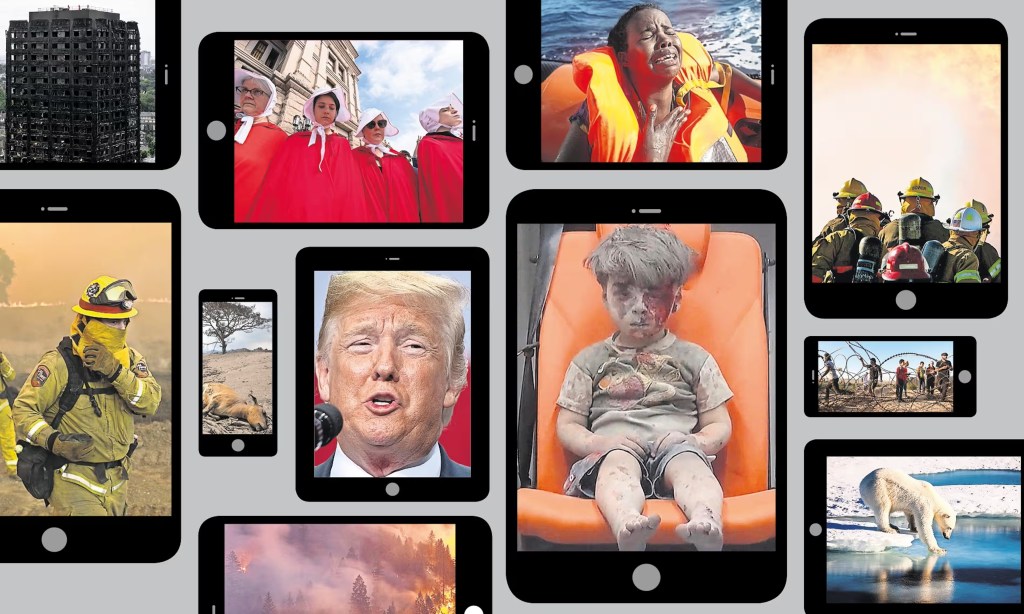
We have never been more aware of the appalling events that occur around the world every day. But in the face of so much horror, is there a danger that we become numb to the headlines – and does it matter if we do?
In April this year, a woman calling herself Apathetic Idealist wrote to an advice columnist at the New York Times, asking for help in overcoming a sense of political paralysis. This condition, which was keeping her from engaging in “real action”, began in November 2016, when Donald Trump won the US presidential election. “I continue to be outraged by this administration’s treatment of Latinos, Native Americans, Muslims, LGBT folks, women and so many others,” she wrote. “But I’m struggling to summon a response.”
“I have no doubt that many people can relate to your letter. I can relate to it,” began the response from the columnist, Roxane Gay. “It is damn hard to expand the limits of our empathy when our emotional attention is already stretched too thin.” This seems to be an increasingly common condition. Glance at Twitter or Facebook, and you’ll probably see someone say, “I’m so tired”. There is so much bad news that it feels like we’re running out of emotions. I can relate to Apathetic Idealist, too. For the past several months, I have experienced a creeping psychic exhaustion.
It wasn’t always like this. In the months after Trump’s election, my husband, John, printed out the phone numbers of our government representatives in Colorado, where we live, and stuck them on the fridge. We started calling them weekly, demanding, even begging them to fight on our behalf – to defend the Americans with Disabilities Act, to fight the attacks on minorities and immigrants and trans people, to fight for gun control.
Sometimes the public outcry seemed to work. A rushed Republican bill to repeal and replace the Affordable Care Act – a flawed but important step toward universal healthcare, established under Barack Obama – failed to find support. It felt like a victory. But a few months later, those same senators cut billions from government healthcare programmes under the guise of “tax reform”. I made a number of calls to my representatives about the tax plan, but it didn’t help; this time, the Republicans in Congress had enough votes to pass their plan into law. I haven’t called my senators in months. It was starting to feel like a waste of time and energy. On most occasions, our Republican senator’s office doesn’t even answer the phone. Most of the time, outrage itself feels largely useless.
There’s a clinical name for what Apathetic Idealist and many of us are feeling: it’s called compassion fatigue. Psychologist Charles Figley defines compassion fatigue as “a state of exhaustion and dysfunction, biologically, physiologically and emotionally, as a result of prolonged exposure to compassion stress”. Symptoms include behavioural changes (becoming easily startled, a reduced ability to remain objective), physical changes (exhaustion, anxiety and cardiac symptoms) and emotional changes (numbness, depression, “decreased sense of purpose”). It is an important framework in professions such as nursing, where over-exposure to trauma can lead to health problems for the nurses and worsened outcomes for patients. But it can and has been applied to the general population, too, especially when we are saturated with pleas for attention.
Though the term is relatively new, the idea of compassion fatigue has been around for centuries. As historian Samuel Moyn recently put it: “Compassion fatigue is as old as compassion.” And the anxieties that come with our awareness of compassion fatigue go back just as far. According to Moyn, the 18th-century philosophers and moralists who “rooted ethics in sentiment and sympathy” were simultaneously troubled that “devoting oneself to an ethic of exposure and sensitivity to others’ suffering (or of engagement and action to relieve it) might lead to a numbed ethical sense”. It was partly this worry that emotional fatigue could undermine our morals that led Immanuel Kant to abandon sentimentalism for an ethics based in reason – a more objective alternative, at least in theory.
The debate around the value of compassion has continued into the 21st century. There are those who argue, following Kant, that a subjective experience of empathy should not be required for moral action, and those who go further, contending that empathy actually gets in the way of morality. But the more commonly held view today seems to be that empathy is vitally necessary, not just for direct human interaction, but as a spur to solve the world’s most pressing problems. Why would we come to the aid of people who are suffering, the thinking goes, if we don’t on some level feel their suffering, too?
If it is true that empathy is a necessary motivator for making the world a better place, what happens when we feel bombarded every day with the details of local and global disasters, with every shocking crime, political scandal and climate calamity here and abroad? The war in Syria. Refugee crises. Melting sea ice. Professionals on the frontlines of trauma are trained to watch for signs of “compassion fatigue”, but lately it feels as if everyone is at risk.
The term “compassion fatigue” first appeared in print in a 1992 article by the writer and historian Carla Joinson. While observing nurses in emergency departments, Joinson noticed “a unique form of burnout that affects people in the caregiving profession”. In the early 90s, Figley explored these ideas further. He identified how professionals providing “empathic support” to people with post-traumatic stress disorder can themselves begin to exhibit some of the same symptoms as their patients, such as anxiety and other emotional changes. According to Figley, trauma spreads to people who work in areas such as healthcare – not only because they are more likely to be exposed to those who are traumatised, but because caring is often inherent to their sense of self: empathy as a liability. Figley, who had served in Vietnam, went on to adopt and popularise Joinson’s term, and became a major advocate for compassion fatigue awareness.
The effects of compassion fatigue on healthcare workers are real and documented. Left untreated, it leads to reduced quality of care, an increase in clinical errors, and high employee turnover. Caregivers take these symptoms home, as well, harming their relationships with friends and family. Accordingly, caregivers are instructed to monitor themselves for signs of compassion fatigue. A textbook authored by Figley includes self-assessments to test your “ego resiliency”, “self-compassion” and “post-traumatic growth” – that is, the “positive changes that some trauma survivors report as a result of the struggle to cope with traumatic events”.
Caregivers are coached to follow various established guidelines of self-care in order to ward off compassion fatigue, or to recover if it has already struck. These include physical, psychological and social commitments such as maintaining healthy eating and sleeping habits, making time for relaxation and meditation, and building a social support network, including at least two people who can be counted on to be “highly supportive”. If trauma is communicable, one hopes those supporters have a support network of their own.
Not long after compassion fatigue emerged as a concept in healthcare, a similar concept began to appear in media studies – the idea that overexposure to horrific images, from news reports in particular, could cause viewers to shut down emotionally, rejecting information instead of responding to it. In her 1999 book Compassion Fatigue: How the Media Sell Disease, Famine, War and Death, the journalist and scholar Susan Moeller explored this idea at length. “It seems as if the media careen from one trauma to another, in a breathless tour of poverty, disease and death,” she wrote. “The troubles blur. Crises become one crisis.” The volume of bad news drives the public to “collapse into a compassion fatigue stupor”.
By Moeller’s account, compassion fatigue is a vicious cycle. When war and famine are constant, they become boring – we’ve seen it all before. The only way to break through your audience’s boredom is to make each disaster feel worse than the last. When it comes to world news, the events must be “more dramatic and violent” to compete with more local stories, as a 1995 study of international media coverage by the Pew Research Center in Washington found.
Moeller claims compassion fatigue is not inevitable, and that the media can fight it by providing coverage that is neither formulaic nor sensationalised. “More graphic is not better,” she writes, and believes fatigue is a reasonable response to a barrage of terrible images.
I have reached the point where being shocked feels normal; it is a fact I hold in my mind but don’t feel in my body. I would like to follow the guidelines of self-care, to preserve my “emotional endurance”, not as a professional caregiver, just as a regular person who cares about the world. So I take breaks and try to reduce my stress. I go out with friends, I watch old poker tournaments on YouTube. But my breaks are getting longer. They feel dangerously close to avoidance.
That distance is better, I suppose, than feeling hopelessly enraged. But what is my responsibility? How much am I supposed to know about global suffering, and what can I really do with that knowledge? Social media, 24-hour news, alerts on my phone – the demands on our compassion are much higher than a caveman or Kant had to contend with. It is overwhelming, even paralysing, and very likely makes me less effectual in the local spaces where I might actually be able to do some good. Whether or not I keep up with everything happening everywhere, all the time, I know that the information exists; that awareness alone is fatiguing. It’s very easy to succumb to fatalism, which is perhaps the logical extension of compassion fatigue – believing that we’re screwed no matter what we do is mysteriously tempting.
Do we need to feel bad in order to do good? The psychologist Paul Bloom, who wrote a book called Against Empathy, argues – or perhaps hopes – that we can be moral without depending on empathy, which is biased and unreliable. We shouldn’t dole out aid in accordance with the amount of sympathy we feel for people; we should help the people who need the most help. The answer, in Bloom’s mind, is not to dial up our sympathy for everyone to unsustainable levels, but dial it down so we can approach problems more logically.
There are many forms of activism, and maybe writing is mine. I have skipped several public protests recently, feeling I had too much other work to do. But I was heartened that people I knew attended. I liked the photos they posted on social media – I felt inspired by the size of the crowds, knowing others had the time and energy to march in the streets for what we all believed. It is comforting to think that when we’re too fatigued to fight, someone else will take the lead. It is, perhaps, too comforting.
Read the original, unedited version of the article here.
Reading notes:
- The author starts with the example of a woman (nicknamed “Apathetic Idealist”) who is struggling to feel compassion for the things she witnesses;
- Gabbert argues that this is an increasingly common condition: being constantly bombarded with bad news, people are bound to feel emotionally exhausted;
- Next, the author says this is a new development; in the past, there was a general feeling that individuals still had the power to change things;
- While in the past, public outcry had the ability to bring about political change, nowadays, individual outrage feels like a waste of energy;
- The clinical name for this condition is “compassion fatigue”, which is described by clinicians as the inability to experience emotions resulting from prolonged exposure to compassion stress; nurses, in particular, often suffer from it; the term has been applied to the general population as well;
- Albeit the term is new, the phenomenon is ancient; to escape compassion fatigue, philosophers (such as Kant) advocated for an ethics rooted in reason, free of sentimentalism;
- Albeit some argue that compassion might stand in the way of morality, the feeling nowadays is that compassion is essential to solving the world’s problems: to help those who suffer, people should, on some level, feel their suffering;
- However, given the number of calamities and disasters happening around the world – constantly reported in the news – people find it challenging to experience compassion any longer; professionals are no longer the only ones exposed to the risks of compassion fatigue;
- The term “compassion fatigue” was first used in the 90s, and it was applied to those working in the caregiving profession, such as nurses; caring for other people, and showing empathy, became a liability that often resulted in emotional burnout;
- Compassion fatigue is so widespread among caregivers that they are instructed to recognize its symptoms as it can affect both work efficiency and social relationships;
- Given this, caregivers are also instructed to follow specific guidelines to ward off compassion fatigue or to cope with it if they have been affected; these include maintaining a healthy lifestyle and creating a social support network;
- The concept then started to be used in media studies as well: bombarded with bad news daily, people can experience compassion fatigue and the inability to summon emotions in response to what they see and hear;
- When it comes to world news, studies show that compassion fatigue can become a vicious circle: to stir emotions in the audience, world events need to sound even more dramatic and terrifying (compassion fatigue is so widespread that the only way to shock people is to make one crisis look worse than the others);
- While compassion fatigue is inevitable, the media can fight it by avoiding sensationalistic headlines;
- To alleviate compassion fatigue, the author recounts that she often takes breaks from the news and does things to distract her from them, but these breaks often feel like avoidance;
- The author argues that there is a limit to the amount of care individuals can dedicate to what happens in the world; because of this, fatalism, the idea that the world is screwed and that nothing can be done about it, sounds tempting;
- Psychologists argue that when faced with such circumstances, people shouldn’t increase their levels of sympathy but, on the contrary, lower them to the point where they can make rational decisions and help those who really need help;
- The author concludes by saying that writing is her form of activism and that sometimes the idea that someone else will take the lead and fight for people’s rights and beliefs might just be too comforting;
Summary of Elisa Gabbert’s article “Is Compassion Fatigue Inevitable in an Age of 24-Hour News?”:
Option 1:
In the article “Is Compassion Fatigue Inevitable in an Age of 24-hour News?” published in The Guardian on August 2, 2018, Elisa Gabbert examines whether exposure to constant crises can lead to emotional burnout. Gabbert explains that “compassion fatigue” was coined in 1992 and is defined as exhaustion and dysfunction resulting from long-term exposure to stressful situations, such as caregiving. This can cause behavioural changes, physical symptoms such as exhaustion and anxiety, and emotional difficulties such as depression and a lack of purpose. Although her analysis examines theories, it is, above all, personal and self-critical.
Although the term “compassion fatigue” is relatively new, the debate over whether moral action requires emotional investment or empathy has been discussed in the study of ethics for centuries. Some argue that empathy is unnecessary and can even be detrimental to humans acting responsibly and morally. Decisions can be made based on emotional investment rather than logic. However, most believe empathy and compassion are essential to contribute to or address the world’s problems.
Reporters may intensify news coverage to attract attention, which can cause readers and viewers to withdraw from overexposure to media reports and images of poverty, disease, and death. This can lead to a cycle of emotional stress and horror.
Gabbert admits that being shocked by what is happening has become routine, but her “outrage” feels futile. She feels the need to distance herself but wonders what her responsibilities are. With round-the-clock news coverage, the pressure on people’s attention and sensitivity can seem overwhelming. She speculates that the logical conclusion to compassion fatigue could be an acceptance of “fatalism.” She confesses that the idea that bad things will happen regardless of her involvement or lack thereof is appealing. She is comforted knowing that other people are actively involved, even when she is temporarily disengaged, but she still feels guilty.
Option 2:
In her article “Is Compassion Fatigue Inevitable in an Age of 24-hour News?” published in The Guardian on August 2, 2018, Elisa Gabbert delves into/ explores/ scrutinises/ surveys the topic of emotional burnout, which is becoming increasingly prevalent nowadays. Gabbert wonders whether exposure to constant crises and news reports has made compassion fatigue/ emotional burnout an inevitable response.
Gabbert explains that “compassion fatigue” is a term coined in 1992 and is defined as exhaustion and dysfunction that results from long-term exposure to stressful situations, such as caregiving professions. It can lead to a host/ a bevy of adverse outcomes, including behavioural changes, physical symptoms like exhaustion and anxiety, and emotional difficulties such as depression and a lack of purpose.
Albeit the term is relatively new, the question of whether moral action requires emotional investment or empathy has been a topic of discussion in the study of ethics for centuries. Some argue that empathy is unnecessary and can harm humans acting responsibly and morally. Emotional investment can lead to decisions being made based on feelings rather than logic. However, most people acknowledge the importance of feeling empathy and compassion for the sufferers to contribute to or address the world’s problems.
The current state of news reporting has made it necessary for reporters to ratchet up the latest news event as more awful than the last to attract attention. However, this overexposure to media reports and images of poverty, disease, and death can lead to readers and viewers withdrawing from the news and being unable to cope with the emotional stress and other horrors.
Gabbert admits that being shocked by what is happening is now a state of normalcy for her, but her ‘outrage’ feels futile. She senses the need to distance herself but wonders what her responsibilities are. With round-the-clock news coverage, the demands on people’s attention and sensitivity can seem overpowering. She speculates that the logical conclusion to compassion fatigue could be an acceptance of “fatalism.” She confesses that the idea that bad things will happen irrespective of her involvement, or lack thereof, is seductive. She is comforted that other people are actively involved, even when she is temporarily disengaged, but evidently, she suffers from guilt.
 The Summariser