For exam purposes, below is an edited version of the original text:
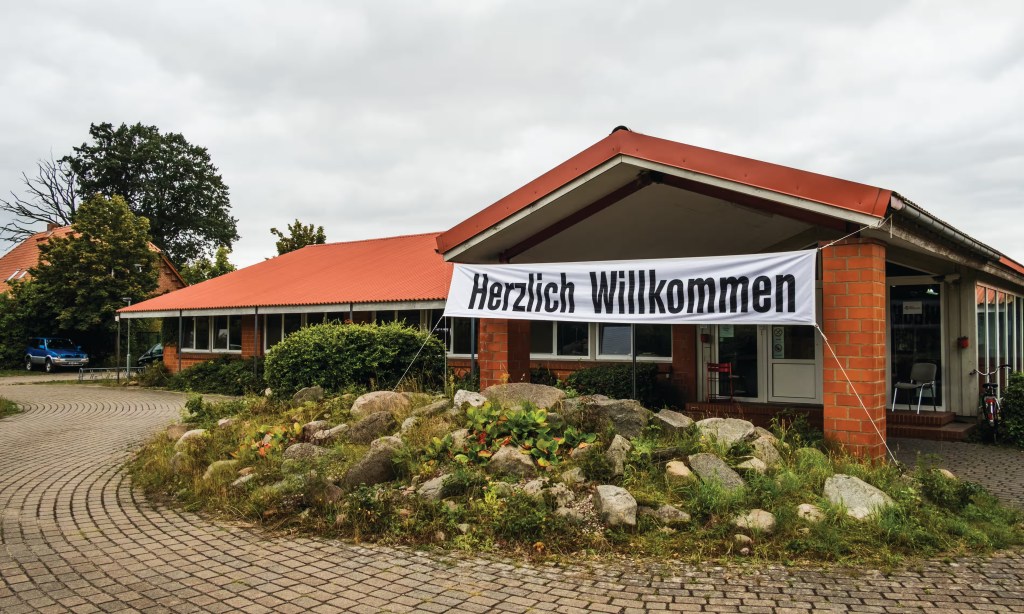
In the autumn of 2015, Germany designated the hamlet of Sumte as a sanctuary for hundreds of displaced people. What followed was a test of the country’s deepest principles.
There is no cinema in Sumte. There are no general stores, no pubs, gyms, cafes, markets, schools, doctors, florists, auto shops or libraries. There are no playgrounds. Some roads are paved, but others scarcely distinguish themselves from the scrub grass and swampy tractor trails surrounding each house – modest plots that grade into the farmland and medieval forests of Lower Saxony. There is no meeting hall. All is private and premodern.
One day in October, after a thousand years of evening gloom, a work crew arrives and lines the main avenue with LED streetlamps. The lights are a concession to the villagers – all 102 of them – from their political masters in the nearby town of Amt Neuhaus, who manage Sumte’s affairs and must report to their own masters in Hanover, who must report to Berlin. It’s this vague chain of command that most alienates the people of Sumte. No-one tells them anything.
Which is not to suggest anyone here is unaware of what’s going on in the world in 2015. Word has reached Dirk Hammer, the bicycle repairman, and Walter Luck, the apiarist, about the capsizing trawlers, the panic in Lampedusa. They watch the nightly news. They’ve heard of this crisis. And they wonder where these people – more than a million of them – are headed. The streetlights, a long-standing request now mysteriously granted, make them suspicious.
Only Reinhard Schlemmer watches the workmen and knows for sure. He was Sumte’s mayor when the border came down, a decorated party member, and his bearing still suggests something of the phrase “pillar of the community”. After reunification, as farming collectives dissolved and unemployment rose, Schlemmer came up with a shrewd plan to save Sumte from extinction. He convinced a rich businessman in Hanover to invest in the construction of a huge complex on its outskirts, a private village-within-the-village where East German women would train to become caseworkers for a debt-collection agency.
The plan worked. The office opened in 1994 and for almost 20 years, the agency provided jobs for 250 women from Sumte and neighbouring towns in Lower Saxony, becoming the area’s largest employer. But the 2008 financial crisis razed the debt market, and in 2012 the agency, now called Apontas, decided to consolidate its operations in Hanover. The complex has stood empty ever since.
It’s an oddly warm October morning when Grit Richter, sitting in her modest mayoral office in Amt Neuhaus, gets a phone call from the interior ministry in Hanover. An administrator explains to her that Sumte will receive 750 asylum seekers starting at the end of the month, to be housed in the Apontas office complex. Richter isn’t sure she’s heard correctly. Yes, the administrator says, they know that Sumte is small. They also know that the complex is empty and disused. But the village has something that no other town in the area can boast: 21,000 square feet of dry shelter. Her options, she’s told, are to say “yes” or “yes”. She hangs up. She doesn’t yet know that Reinhard Schlemmer has been busy making phone calls of his own, offering up the Apontas complex and setting this new idea in motion. Before long, news of the thousand refugees has spread up and down the Elbe. She schedules an emergency meeting at the Hotel Hanover, Amt Neuhaus’s only inn.
Four hundred local people have crammed themselves inside, backed all the way to the foyer. Someone has also alerted the media, and Richter eyes without affection the journalists who are pressed against the back doors, interviewing her constituents. The story, it seems, is a perfect metaphor for the crisis –750 refugees to 100 villagers, an overwhelming invasion – and Richter knows that the journalists are hoping to capture a panic. She walks to the stage and starts talking as calmly as she can. At the back of the hall, two agitators from the National Democratic Party (NPD) unfurl a large “Germany for Germans” banner and heckle the crowd with cries of “asylum terror”. Other locals are quick to escort them out of the hall. There is no swell of support around here for the extreme right, unlike in many neighbouring areas. But it’s too late to keep the press away.
Once the NPD activists are gone, Richter distributes cold facts: the EU is taking on 5,000 new migrants every day and is expected to have received at least 3 million by the end of 2017. Germany will have 800,000 new migrants by the end of this year, and it appears that most will be allowed to stay. There are tough decisions to be made in every town in Germany and this much has been settled for them: the building complex in Sumte will be leased for one year to the Workers’ Samaritan Federation (ASB), a private charity that specialises in disaster relief. Maximum occupancy will be maintained throughout the year. They will all regroup and reassess next October.
Jens Meier, director of the regional ASB office, speaks next. He tells the crowd that he will permit no mischief in the Sumte camp and tolerate no intimidation from outside. They’re going to hire Arabic-speaking guards and set up perimeter fences. The residents will be free to come and go as they please, but townsfolk will need an invitation to enter, he says. The asylum seekers, who will soon arrive from Syria, Albania, Sudan – 18 beleaguered countries in all – must be protected. But there’s good news, too, he says. There will be somewhere between 60 and 80 job openings at the camp, from janitors to German instructors. “The whole world is watching,” he says. And for a few weeks, he’s right.
Germany ratified its current constitution in 1949. Constitutions tend to reflect the conditions under which they were drafted, and Germany’s is concerned with the threat of dictatorship and the plain, unambiguous assertion of human rights. The first sentence of its first article reads, in its entirety, “Human dignity shall be inviolable.” Its creators even added a clause enshrining the right to asylum for persons escaping political persecution “without discrimination as to race, religion or country of origin.”
Then, two years ago, more than a million asylum seekers crossed into Europe, and the UN had no idea what to do. The world’s displaced had been steadily growing in number for years, increasing by more than 50% since 2011. Most of the externally displaced found refuge in other impoverished countries, as is nearly always the case; just 4% made it into any part of the European Union. In August 2015, as 100,000 people stood at the closed Hungarian border, the Germans reflected on their constitutional duty. This was long before the rise of Donald Trump and the resurgence of a strain of nativist populism within Germany. The mood was sufficiently humanitarian in those days that Germany’s chancellor, Angela Merkel, felt compelled to utter three now-infamous words: “Wir schaffen das.” (We’ll manage it, or We’ll do it.) Meaning: we’ll accept any legitimate political refugees who can reach us. The words marked the beginning of a new kind of civic experiment. Now Germany was actually going to try to uphold the spirit of its 60-year-old constitution, with its singular concern for human dignity.
Some saw Germany’s stance as an attempt to make a kind of ultimate atonement for historical sins: a radical penance underwritten by the guiltiest country in the modern world. But to actually revisit the summer of 2015 is to remember that Germany did not plan to act by itself. All members of the European Union were expected to uphold the commitments to international asylum to which they’d agreed. A handful of rich countries with small populations – Sweden, Switzerland, Austria, the Netherlands, and Denmark – did resettle comparatively large numbers of refugees. Otherwise, except for a paltry few thousand in France and Italy, none of it happened. Germany stood alone.
By December 2015, Sumte’s population has tripled – 102 citizens, 229 displaced and stateless guests. Asylum seekers are streaming into Germany, and those assigned to Sumte continue to arrive daily by the busload only to disappear into the fenced-off camp. An Advent concert at St Mary’s, the Protestant church in Amt Neuhaus, offers the first opportunity for commingling. Villagers and refugees pack into the old brick church to listen to an evening of carols and hymns, and to satisfy their mutual curiosity. Near the end of the night, 70 well-rehearsed, mostly Syrian children rise to sing O Tannenbaum, and for a moment there can be no argument about the goodness of what’s being done here. Behind the scenes, Jens Meier of the ASB is the busiest man in Lower Saxony. A sign on the community bulletin board in Sumte advertises openings for nurses, cleaning crews, drivers, caretakers, tutors, and social workers. By Christmas, the camp hallways echo with the polyglot cries of 189 children.
A few weeks later, on a bus in Lower Saxony, I scroll through reports about the mass sexual assaults at New Year’s Eve celebrations in Cologne. By now the eyewitness accounts have given way to right-wing demagoguery. The perpetrators, it is believed, included several refugees, or if not refugees at least Muslims – at the moment, no one seems sure. Although the attack is an anomaly, and although most of the refugees have been peaceful and law-abiding, the national mood toward Merkel’s asylum politics has curdled. The right-wing populist party Alternative für Deutschland agitates for the removal of refugees and the closing of borders. There commences a string of attacks on asylum shelters that police seem unable to stop. Meier’s anxiety about safety seems justified. Some of the refugees start to leave.
Meier can’t stop them from leaving. Between the isolation and the shock of the frigid German winter, he says, the unmarried men became despondent. The desire to leave outweighs their monthly stipend. “There’s nothing here for a foreigner,” they say. No jobs, no opportunities, and – not a small matter – no way to meet women.
In March, four countries – Croatia, Serbia, Slovenia, and Macedonia – close their borders in response to the 123,000 migrants who landed in Greece at the start of 2016. This impasse slows the inflow of migrants to a trickle. By May, Meier has corrected most of the shortcomings that had troubled the camp in its first months. The internet works. There is a fine canteen, a laundry service, shuttle buses to Amt Neuhaus, the teen centre, schoolrooms, a mobile phone shop, a medical centre, therapists’ offices – even a movie night, the programming of which is determined by a committee of resident mothers. (“They insisted that it should all be in German,” Meier says. It’s the first cinema Sumte has ever had.)
He has more time to improve the camp now that so few residents are left to care for. Into the summer, more and more people leave of their own accord, not just men now but couples and families. Just 80 residents remain, mostly families with young children. I ask Meier whether he thinks the camp will continue to accept any new refugees. “If the refugees can get here,” he says, “we’ll take them. We’ll take them all.” Now politicians in Europe have closed the borders. Merkel has made her deal with Turkey. Yet none of the problems that created these mass movements of people in the first place have been solved. Assad continues to bomb his own citizens with impunity, he says. Afghanistan and Iraq are fracturing. “These are big problems,” he says. “Our families here come from war, they come from total poverty.” This is the world Meier is responding to: the world’s 65 million uprooted.
In September the refugees are gone. About 80 have settled around Amt Neuhaus in Soviet-era apartment blocks, but the rest have left. In her office, Richter says the camp was a great success. There were no Nazis, no mobs, no violence. That’s all she could have hoped for. It’s sad that the camp closure will mean the loss of work, she says, but where was the public outcry when Apontas moved away? Which isn’t to say they wouldn’t do it again. “Of course we would,” she says, “but we wouldn’t necessarily be happy about it.” She thinks for a minute. “Although we did get the streetlamps.”
Reading notes:
- Sumte is described as a desolate, underdeveloped village in Germany;
- Unexpected change: things start to change in the village (new LED lamps); the changes come from above in the chain of command;
- The villagers begin to understand there is something behind these changes: they begin to make connections between the refugee crisis and the sudden changes happening close to their homes;
- While the villagers can only guess what’s going on, the former mayor of Sumte, who had saved the village from extinction by convincing a rich guy to build a complex on its outskirts, knows precisely what’s going on;
- The complex, called Apontas, served its purpose by providing jobs for the locals; however, when the financial crisis hit, it remained unoccupied;
- Apontas is somewhat forcibly chosen to host 750 refugees, and the local administration cannot back down;
- The news triggers a somewhat heated debate, and the situation is met with some resistance – there is a considerable disparity between the number of villagers and that of the refugees;
- During a meeting, the villagers are informed of the situation: Germany must absorb the waves of migrants, and Apontas has been leased to house a part of them;
- The villagers are reassured that safety will be maintained and that job opportunities will be provided for them; the experiment in Sumte is supposed to become a model/blueprint for other countries to follow;
- The German constitution guarantees dignity and safety to those who escape political persecution;
- Given the refugee crisis and the precepts of the German constitution, Germany is put to the test of upholding those precepts;
- Despite existing agreements between the different countries of the European Union, Germany (and Italy) found themselves alone in tackling the crisis;
- In the beginning, as villagers and refugees begin to intermingle in social activities and job openings start to appear, the experiments seem to be working out just fine;
- But a case of mass sexual assaults on New Year’s Eve allegedly involving the refugees triggers political opposition, and some of the refugees begin to leave;
- Unmarried men leave due to a lack of opportunities and marriage prospects.
- Countries begin closing borders as the crisis intensifies; meanwhile, things in the Sumte camp seem to improve;
- More and more refugees abandon the camp, and the political situation does not improve, particularly in those countries from which the refugees flee;
- The conclusion: all refugees abandoned the camp; there are mixed feelings about the experiment; the experiment is somewhat inconclusive;
Summary of Ben Mauk’s article “102 Villagers, 750 Refugees, One Grand Experiment”:
The German constitution guarantees refugees the right to seek asylum in Germany, and Ben Mauk’s article “102 Villagers, 750 Refugees, One Grand Experiment,” published in The Guardian in April 2017, reports on Angela Merkel’s commitment to this right, with a specific focus on the village of Sumte in Lower Saxony in 2015/16.
In the autumn of 2015, the village of Sumte was informed that a large empty complex had been leased to a private charity specializing in disaster relief. They were told to expect 750 refugees fleeing Syria, Sudan, and other war-torn areas. The villagers initially tended towards humanitarianism and tried their best to make the centre work to accommodate the new arrivals. Although they were overwhelmed, they appreciated the job opportunities it created. This mood was reflected throughout much of Germany at the time.
Mauk chronicles how attitudes towards asylum seekers in Germany started to change over time. The intransigent policies of many European countries regarding immigration, which resulted in the closure of borders, also impacted the welfare and morale of the refugees at the Sumte centre. The refugees had to deal with various challenges, such as prejudice, harsh winter conditions, and difficulties in integrating into society or finding long-term employment. As a result, in 2016, they gradually started leaving the village and moving to other places.
In his portrayal of a well-intentioned project, Mauk highlights the complexities of the refugee crisis. The root causes of this mass migration, namely war and poverty, have yet to be effectively addressed. Although a rural German village initially offered immediate shelter for those seeking a new life, it was ill-equipped to provide the necessary amenities such as internet access, a canteen, and school facilities. As a result, most refugees moved elsewhere before these amenities could be established, leaving behind only a handful of families with children. Mauk offers a candid glimpse into the hopes and fears, the disillusionment, and the kindness of individuals caught up in this “experiment” to provide a safe haven for hundreds of displaced people.
 The Summariser