For exam purposes, below is an edited version of the original text:
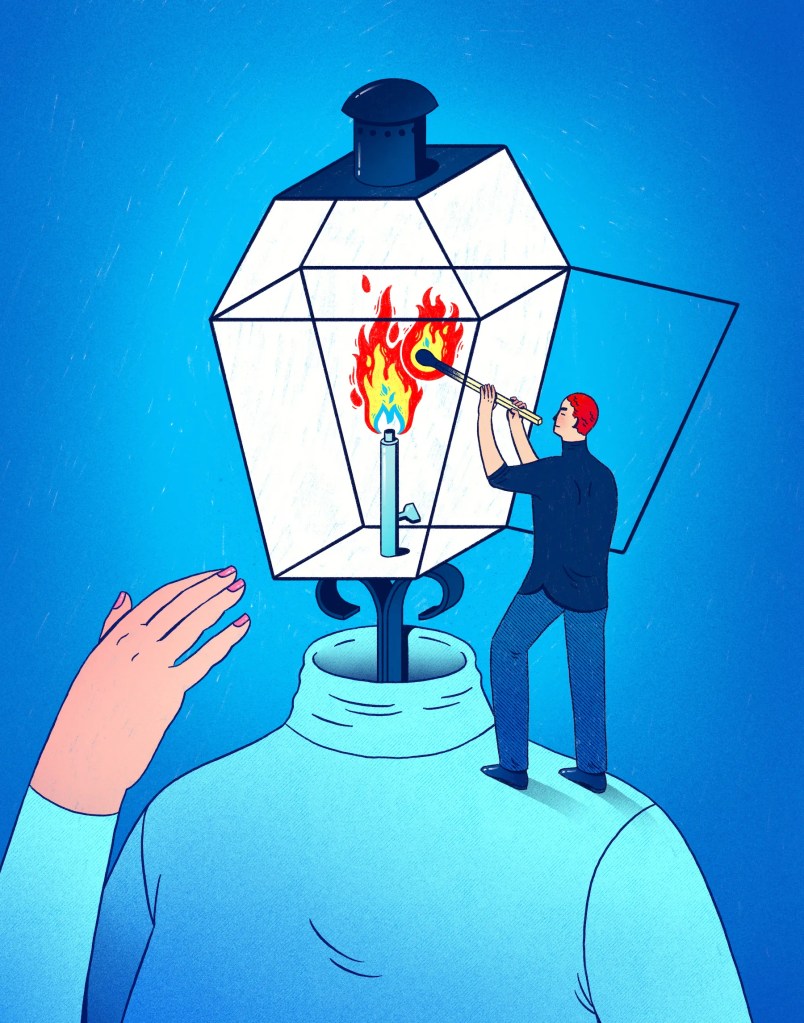
What happens when a niche clinical concept becomes a ubiquitous cultural diagnosis.
When Leah started dating her first boyfriend, she had very little sense that sex was supposed to feel good. In the small town where she grew up, sex education was basically like the version she remembered from Hollywood movies. With her college boyfriend, the sex was rough from the beginning. There was lots of choking and hitting. He would toss her around the bed and reassure her that was how everyone else was doing it.
Sometimes, when they were having sex, Leah would get a strong gut feeling that what was happening wasn’t right. In those moments, she would feel overwhelmed by a self-protective impulse that drove her out of bed to shut herself in the bathroom. However, what she remembers most clearly is not the fleeing but the return: walking back to bed, naked and embarrassed about having acted that way. Her boyfriend would scold her for it and suggest she see a professional to learn how to deal with her feelings.
A few months after they broke up, Leah chatted with a girl sitting beside her in class. It emerged that this girl had gone to the same high school as her ex-boyfriend, and when Leah asked if she knew him, the girl looked horrified and said the guy was a psycho and had a reputation for sexual assault. Some of what the girl described sounded eerily familiar.
Leah returned to her dorm room and lay in bed for almost two days. She kept revisiting memories from the relationship, understanding them in a new way. What she’d understood as “normal” sex had been something more aggressive. And her ex’s attempts to convince her otherwise were a kind of controlling behaviour so elemental that she did not have a name for it. Now, six years later, she calls it “gaslighting.”
Gaslighting is a term that has gained a lot of attention lately, with it being named Merriam-Webster’s “Word of the Year” in 2022 due to a surge in searches for the term. It refers to a form of protracted psychological manipulation, causing the victim to question their thoughts, reality, and memories. This often leads to confusion, loss of confidence, low self-esteem, uncertainty about one’s emotional or mental stability, and dependence on the perpetrator. The term’s popularity indicates a widespread desire to name this type of harm, but what are the implications of diagnosing it everywhere?
The term “gaslighting” comes from the title of George Cukor’s film Gaslight, from 1944, a noirish drama that tracks the psychological trickery of a man, Gregory, who spends every night searching for a set of lost jewels in the attic of a townhouse he shares with his wife, Paula. The jewels are Paula’s inheritance, and we understand he has married her to steal them. During his nighttime rummaging, Gregory turns on the gas lamps in the attic, causing all the other lamps in the house to flicker. But, when Paula wonders why they are flickering, he convinces her that she must have imagined it. Filmed in black-and-white, the film offers a clever inversion of the primal trope of light as a symbol of knowledge. Here, light becomes an agent of confusion and deception, an emblem of Gregory’s manipulation.
The actual psychology of gaslighting emerged as an object of study in 1981 when The Psychoanalytic Quarterly interpreted it as a version of a phenomenon known as “projective identification,” in which a person projects onto someone else some part of himself that he finds intolerable. Gaslighting involves a “special kind of ‘transfer,’ ” they write, in which the victimiser, “disavowing his or her mental disturbance, tries to make the victim feel he or she is going crazy, and the victim more or less complies.”
Philosophy has also turned its gaze to the phenomenon in the past decade. In 2014, a philosophy professor at the University of Indiana, Kate Abramson, published an essay called “Turning Up the Lights on Gaslighting.” The core of Abramson’s argument is that gaslighting is an act of grievous moral wrongdoing which inflicts “a kind of existential silencing.” Gaslighting essentially turns its targets against themselves, she writes, by harnessing “the very same capacities through which we create lives that have meaning to us as individuals,” such as the capacities to love, to trust, to empathise with others, and to recognise the fallibility of our perceptions and beliefs.
Abramson defines the phenomenon by specifying what it isn’t. Gaslighting is not the same as brainwashing, for example, because it involves not simply convincing someone of something that isn’t true but, instead, convincing that person to distrust their capacity to distinguish truth from falsehood. It is also not the same as guilt-tripping because someone can be aware of being guilt-tripped while still effectively being guilt-tripped. At the same time, her examples of gaslighting sometimes grow uncomfortably expansive.
The psychoanalyst and historian Ben Kafka, who is working on a book about how other people drive us crazy, told me that he thinks our most familiar tropes about gaslighting are slightly misleading. He believes that, although romantic relationships, such as that of Leah and her violent boyfriend, dominate our cultural narratives of gaslighting, the parent-child dynamic is a far more helpful frame. The power imbalance between parents and their children is intrinsically conducive to this manipulation. Indeed, it often happens unwittingly: if a child receives her version of reality from her parents, she may feel that she has to consent to it to ensure that she continues to be loved and nurtured.
Many memoirs recount experiences one might call gaslighting, but few trace the lasting residue of parental gaslighting as deftly as Lily Dunn’s Sins of My Father. When Dunn was six, her father left the family to join a cult called the sannyasins and preached a doctrine of radical emotional autonomy. At thirteen, Dunn went to spend the summer at her father’s villa in Tuscany, where one of her father’s middle-aged friends began seducing and sexually harassing her. When Dunn confronted her father about these sexual advances, he replied that she shouldn’t be worried. For years after that incident, Dunn continued to doubt her emotions because she’d been consistently told by her father that she felt too much and that she needed to deal with these feelings on her own.
Sitting in Kafka’s office thinking of Dunn and her experience, I found myself swelling with anger on behalf of such gaslit children, taught to feel responsible for the pain their parents had caused them. But beneath that anger lurked something else—a nagging anxiety coaxed into sharper visibility by the therapeutic aura of Kafka’s sleek analytic couch. I eventually told him that I had also started to wonder about the ways I might be unintentionally gaslighting my daughter—telling her, for instance, that she is “just fine” when she clearly isn’t. In these interactions, I can see the distinct mechanisms of gaslighting at work, albeit in a milder form: taking a problematic feeling and placing it onto her. Part of me hoped that Kafka would disagree with me, but he nodded vehemently instead and said countless parents gaslight their children, off-loading their anxiety on them.
Gila Ashtor, a psychoanalyst and a professor at Columbia University, told me she often sees patients experience a profound sense of relief when it occurs to them that they may have been gaslit. But Ashtor worries that such relief may be deceptive in that it risks effacing the particular (often unconscious) reasons they may have been drawn to the dynamic. For Ashtor, it’s not a question of blaming the victim but of examining their susceptibility: what makes someone ready to accept another person’s narrative of their own experience? What might they have been seeking?
Ashtor thinks that therapeutic examination of a gaslighting dynamic can bring you closer to understanding something crucial about yourself: a complicated relationship to motherhood, say, or the effects of specific imbalances or conflicts in your parents’ marriage. The work is to “understand what’s getting enacted and why.” In working with patients to better understand their experiences of being gaslit, Ashtor hopes to give them a different way to engage with the impulses that led them there.
But what does the gaslighter want? The question of the gaslighter’s motivation often becomes a chicken-or-egg dilemma: whether their impulse to destabilise another person’s sense of reality stems primarily from wanting to harm that person or from wanting to corroborate their truth. Think of Leah’s boyfriend, who convinces her that all sex involves violence—is his fundamental investment in controlling her or in somehow justifying his desires? Abramson writes that both goals can be at play simultaneously, such that a gaslighter may be “trying to radically undermine his target” and also, “in a perfectly ordinary way, trying to tell himself a story about why there’s nothing that happened with which he needs to deal.” If the need to affirm one’s version of reality is pretty much universal, it makes sense that a desire to attack someone else’s competing version is universal, too. Yet, in the popular discourse, it can seem as if everyone has been gaslit, but no one will admit to doing the gaslighting.
Gaslighting is not a clinical diagnosis, but less precise applications of the term can be a way to take an inevitable source of pain—the fact of disagreement or the fact that we are not the centre of other people’s lives—and turn it into an act of wrongdoing. This is not to say that gaslighting doesn’t exist, but that, in seeing it everywhere, we risk not just diluting the concept but also attributing natural human friction to the hostility of others.
Part of the tremendously broad traction of the concept, I suspect, has to do with the fact that gaslighting is adjacent to so many typical relationship dynamics: not only disagreeing on a shared version of reality but feeling that you are in a contest over which version prevails. It would be nearly impossible to find someone who hasn’t experienced the pain and frustration—utterly ordinary but often unbearable—when your sense of reality diverges from someone else’s. Because this gap can feel so annoying and wounding, it can be a relief to attribute it to villainy.
In this sense, gaslighting is both more and less common than we think. Extreme cases undoubtedly occur and deserve recognition. However, understanding the phenomenon exclusively in light of these dire examples allows us to avoid the more uncomfortable notion that something similar occurs in many intimate relationships. One doesn’t have to dilute the definition of gaslighting to recognise that it happens on many scales, from highly toxic to undeniably commonplace.
If the capacity to gaslight is more widely distributed than its most extreme iterations would lead us to believe, perhaps we’ve all done more of it than we care to admit. Each of us has been the one making our way back into bed, vulnerable and naked, and each of us has been the one saying, Come back into this bed I made for you.
Read the original article here.
Reading notes:
- The article starts with the story of Leah, who has a tumultuous sex life with her college boyfriend. He frequently chokes and hits her while having sex, but Leah doesn’t perceive it as abusive behaviour because he tells her that it’s normal for everyone.
- Leah sometimes feels something is wrong with her relationship, but her boyfriend invalidates her feelings and advises her to seek professional help.
- After ending her relationship, Leah learns from a former high school classmate of her ex-boyfriend that he had a history of violent and psychotic behaviour.
- Upon reflecting on her past relationship, Leah realises that her boyfriend had led her to believe that their relationship was normal and that she had been a victim of gaslighting.
- Gaslighting is a form of psychological manipulation that causes the victim to doubt their thoughts, reality, and memories. This leads to confusion, loss of confidence, and dependence on the perpetrator. The article explores what happens when gaslighting is identified everywhere.
- The term gaslighting comes from a 1944 film in which a man manipulates his wife into thinking she is losing her mind to steal her inheritance.
- The term was first studied in 1981 in “The Psychoanalytic Quarterly” and explained as a manipulation tactic where the perpetrator makes the victim question their sanity, with the compliance of the latter.
- Philosophers have discussed “gaslighting” as a form of moral wrongdoing that causes victims to turn against themselves.
- According to some philosophers, gaslighting is a complex issue that is hard to define. The examples sometimes span various behaviours, making the problem difficult to pinpoint.
- According to psychoanalysts and historians, “gaslighting” is not limited to romantic relationships. It can also happen in the parent-child relationship, which is more helpful in understanding what it means. In such cases, “gaslighting” often occurs unknowingly because the child feels the need to agree with their parent’s version of reality to continue receiving their love and care.
- The article uses the example of Lily Dunn’s memoir “Sins of My Father” to illustrate gaslighting in the case of the parent-child dynamic. In the book, Dunn recounts her experience of gaslighting, where her father is the perpetrator. When Dunn tried to confront her father about being sexually assaulted by one of his friends when she was only 13, he dismissed her emotions, invalidating them.
- The author starts wondering whether she might also be “gaslighting” her daughter. For example, she sometimes tells her daughter she’s okay when it’s clear she’s not. The psychoanalyst and historian explains to the author that many parents gaslight their children and transfer their anxiety onto them.
- A different approach some psychoanalysts take involves shifting the attention from the perpetrator to the victim. This is done by examining the victim’s vulnerability to the process of “gaslighting.” It’s important to note that this approach doesn’t intend to blame the victim.
- The psychoanalyst suggests that analysing the victim’s vulnerability can enable them to understand and confront the impulses that made them susceptible to being “gaslit” in the first place. This analysis might also reveal underlying issues that have not been addressed, such as a complex relationship with motherhood.
- Gaslighter’s intentions are hard to understand. Do they want to harm or manipulate the other person? Both could be at play. Due to the term’s vagueness, everyone has been gaslit, but no one admits to being the gaslighter.
- Since “gaslighting” is not a clinical diagnosis, using the term loosely can sometimes result in labelling a natural source of pain, such as not being the centre of attention, as an act of wrongdoing. This does not mean that gaslighting does not exist, but it does mean that we risk diluting the concept and misattributing normal human conflict to the malice of others.
- The author believes that “gaslighting” has become popular because it is fundamental to all relationship dynamics. It can be frustrating when two people have different perspectives on reality and struggle to determine the correct one. It is easy to label this as “gaslighting” and assume that one partner is intentionally trying to deceive the other.
- According to the author, gaslighting is both more and less prevalent than people usually assume. The author suggests that viewing the concept of gaslighting only in the context of extreme cases makes it easier for people to ignore the uncomfortable reality that similar behaviour is standard in many intimate relationships.
- The author concludes that many people engage in “gaslighting” and have both been victims and perpetrators.
Summary of Leslie Jamison’s article “So You Think You’ve Been Gaslit”:
In the article “So You Think You’ve Been Gaslit,” published in The New Yorker on April 1, 2024, Leslie Jamison critically examines the widespread application of ‘gaslighting’ within romantic and familial relationships. Originally defined as a tactic that manipulates victims into doubting their reality, memory, and sanity, ‘gaslighting’ has evolved into a catch-all term that sometimes inappropriately ascribes malicious intent to ordinary disagreements.
Jamison traces the term’s historical roots to a 1944 film that brought the concept of psychological manipulation into the public eye. Subsequent psychological analysis in 1981 and philosophical inquiry have deepened the understanding of gaslighting as a strategy where the perpetrator leads the victim to question their sanity and a form of moral wrongdoing that manipulates victims into questioning their self-perception.
Jamison highlights the difficulty of defining gaslighting due to its occurrence across a spectrum of behaviours. While often discussed in the context of romantic relationships, it also occurs within parent-child dynamics, often arising from a child’s need to align with their parents’ views to receive love and support. Jamison shares her personal concern over her potential to inadvertently gaslight her daughter, emphasizing the overly permissive scope the term has assumed. The difficulty in pinpointing a gaslighter’s intentions and the term’s conceptual vagueness has led to its overuse.
This overuse risks diluting the term’s impact, causing genuine cases of psychological abuse to be conflated with normal relational friction, and may mislabel normal interpersonal disagreements as malicious or abusive. Jamison stresses the importance of distinguishing genuine cases of manipulation from common conflicts, advocating for a more nuanced understanding of the term.
She concludes that the prevalence of gaslighting in various forms of relationships suggests that many people have unknowingly participated in both perpetrating and experiencing it. This widespread presence indicates the need for a more refined understanding of gaslighting, recognizing it as a significant yet often misunderstood aspect of interpersonal dynamics.
 The Summariser